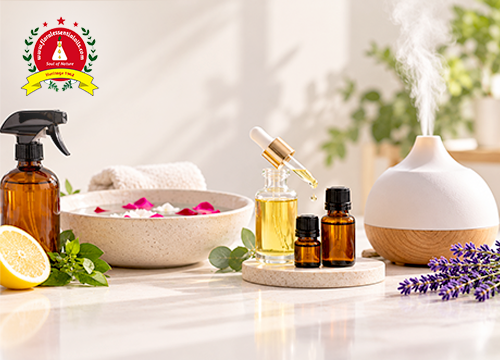
Knowing how to use essential oils is simpler than most labels make it look. In short, you can breathe them in, dilute them for skin, add them to a bath, or clean with them. This guide covers each method, with drop counts, a dilution chart, blending basics and key safety rules.
Key takeaways
- The four main methods are inhalation, diluted topical use, baths and cleaning.
- Always dilute for skin: 1% (2 drops per 10 ml) for the face, 2% for the body.
- Most humidifiers are not built for oils, so use a diffuser unless yours has an aroma tray.
- Good blends balance top, middle and base notes, roughly 30/50/20.
- Store oils in dark glass, cool and capped. Citrus ages fastest.
- Never swallow oils, and take extra care around pregnancy, babies and cats.
What essential oils are (and why the method matters)
Essential oils are concentrated aromatic compounds taken from flowers, leaves, peels, roots, woods and resins. Most are steam distilled. Citrus oils, however, are usually cold pressed from the peel. In Kannauj, where we are based, flowers have been distilled in copper vessels for generations.
Because these oils are so concentrated, the method decides both the result and the risk. For example, one drop of peppermint in a diffuser feels fresh. The same drop neat on the skin, however, can sting.
Extraction also affects aroma and safety. Our guide on cold pressed vs steam distilled essential oils explains why a cold-pressed lemon behaves differently from a distilled one. In addition, the difference between essential oils and absolutes matters when you work with delicate flowers such as rose or jasmine.
How to use essential oils: the main methods at a glance
Each method uses a different amount of oil. As a result, a drop count that suits one method can be far too strong in another.
| Method | Typical amount | Best for | Main caution |
|---|---|---|---|
| Ultrasonic diffuser | 3–5 drops per 100 ml water | Room scent and mood | Run 30–60 minutes, then pause; ventilate |
| Humidifier with aroma tray | 2–4 drops on the pad or tray | Scent during dry months | Never add oil to the water tank unless the maker allows it |
| Steam bowl | 1–3 drops in hot water | Short, fresh breathing sessions | Close your eyes; not for young children |
| Personal inhaler or tissue | 3–5 drops on the wick | On-the-go aroma | Keep capped and away from kids |
| Topical (massage, roll-on) | 0.5–3% in a carrier oil | Massage, skin care, local comfort | Patch test; avoid sun after citrus |
| Bath | 3–6 drops mixed in a carrier first | Unwinding, tired muscles | Oil floats on water, so disperse it |
| Household cleaning | 10–20 drops per 500 ml | Surfaces, laundry, bins | Test on finishes; avoid around cats |
Inhalation: diffusers, humidifiers, steam and inhalers
Inhalation is the most popular way to use essential oils. It is also the easiest to control, because you can simply open a window or switch the device off.
Using an ultrasonic diffuser
An ultrasonic diffuser mixes a few drops with water and releases a fine, cool mist. Start with 3 drops per 100 ml of water and adjust from there.
Also, run it for 30 to 60 minutes rather than all day, because your nose adapts quickly. In addition, clean the tank weekly with a little vinegar.
Can you put essential oils in a humidifier?
The honest answer is: usually not in the water tank. Most standard humidifiers use plastic parts and filters that oils can crack or clog. As a result, oil in the tank can void the warranty.
However, many newer models include an aroma tray or pad. In that case, add 2 to 4 drops to the tray only. Eucalyptus, peppermint and lavender are popular picks during dry months. For a full, model-by-model breakdown, read our dedicated guide to the best essential oils for a humidifier. It covers cool mist units and oils for easier breathing.
Check the manual first. If it does not mention essential oils or an aroma tray, use a separate diffuser instead.
Adding essential oils to steam water
A steam bowl is an old, simple method. Add 1 to 3 drops to a bowl of hot water. Then drape a towel over your head, close your eyes and breathe slowly for 5 to 10 minutes.
Eucalyptus, peppermint and tea tree are traditional choices. However, strong oils can sting the eyes, so start with one drop. Our guide to essential oils to add in steam water lists more options and gentle combinations. Also, skip steam bowls for young children and anyone with asthma unless their doctor agrees.
Personal inhalers and the tissue method
A personal inhaler is a small tube with a cotton wick. Add 3 to 5 drops, close it, and inhale when needed. Alternatively, put one drop on a tissue. Both work well at a desk or on a flight.
How to use essential oils on skin: dilution made simple
Topical use is where most mistakes happen. Essential oils should be diluted in a carrier oil before they touch your skin. Otherwise, they can cause redness, itching or lasting sensitization.
Fortunately, dilution is easy once you know one number. There are roughly 20 drops in 1 ml of essential oil. Therefore, a 1% blend is about 2 drops in 10 ml of carrier oil, and a 2% blend is about 4 drops.
Choosing a carrier oil
A carrier oil is a plant oil that spreads essential oils safely over your skin. Fractionated coconut oil is light, odorless and slow to spoil, so it is ideal for roll-ons. Jojoba is similar to skin’s natural sebum and suits the face. Sweet almond, by contrast, is a massage favorite.
If you want to compare options, see our guide to fractionated coconut oil for hair and skin. For a budget angle, we also list six affordable carrier oils for radiant skin. Olive oil works too, although its scent is stronger. For example, you can mix tea tree oil with olive oil at about 2 drops per 10 ml.
Making a roll-on
- Choose a 10 ml glass roller bottle, ideally amber or cobalt.
- Add 2 drops of essential oil for a 1% blend, or 4 drops for 2%.
- Top up with carrier oil, leaving a little space for the roller ball.
- Cap, roll between your palms to mix, and label it with the date and the oils used.
Roll-ons suit wrists, temples and the neck. For a tension headache, a 1% peppermint roll-on dabbed on the temples, away from the eyes, is the usual approach. Our guide to peppermint oil for headaches explains more. However, see a doctor for frequent or severe headaches.
Massage oils
For a full-body massage, mix a 2% blend: 12 drops in 30 ml of carrier oil. Lavender, sweet marjoram and roman chamomile are traditionally used for relaxing blends. Meanwhile, rosemary and black pepper feel warming after exercise.
Always patch test
First, apply a little of the blend to your inner forearm. Then wait 24 hours. If redness or itching appears, wipe it off with plain carrier oil, wash, and skip that blend.
Baths and foot soaks
Oil and water do not mix. If you drop oil straight into the tub, it floats and touches your skin undiluted. Therefore, a bath needs one extra step.
First, mix 3 to 6 drops into a tablespoon of carrier oil or unscented liquid soap. Then add it to the full bath and swish well. Salts alone do not disperse oil.
For a foot soak, use 2 to 3 drops the same way. Lavender and roman chamomile are gentle choices. However, avoid spicy oils such as clove or cinnamon leaf in the bath.
Around the home: cleaning, laundry and fresh air
Essential oils add a fresh scent to homemade cleaners. Tea tree and lemongrass are traditionally valued for cleansing. However, they do not replace proper disinfectants where hygiene truly matters.
Simple all-purpose spray
Mix 500 ml of water, 100 ml of white vinegar and 15 to 20 drops of lemon, tea tree or lemongrass oil in a glass spray bottle. Shake before each use. Also, test a hidden spot first, since vinegar can dull stone and marble.
For laundry, add a few drops to a wool dryer ball. For fresher rooms, read our guide to essential oils for air purification. In addition, our essential oil cleaning hacks post has quick recipes for kitchens and bathrooms.
How to mix essential oils: blending basics
Blending is the creative side of how to use essential oils. Fortunately, you only need one idea to begin: notes.
Top, middle and base notes
Perfumers sort oils by how fast they evaporate. Top notes, such as citrus, hit first and fade fast. Middle notes form the heart. Finally, base notes, such as vetiver and sandalwood, linger longest.
A simple method for your first blend
- Pick one oil from each note group that you already enjoy on its own.
- Start with 10 drops in total, such as 3 top, 5 middle and 2 base, in a small glass vial.
- Smell it on a paper strip, not straight from the bottle, and write down the ratio.
- Let it rest for a day or two, then adjust one oil at a time.
Easy pairings include lavender, sweet orange and cedarwood for calm evenings. Alternatively, try peppermint, rosemary and lemon for focus. Note that cold-pressed bergamot is phototoxic, so keep it out of daytime skin blends.
To go further, our guide on choosing base notes for your perfume goes deeper into fixatives and dry-down.
How much to buy, storage and shelf life
Knowing how to use essential oils also means knowing how to keep them. Air, light and heat all age an oil. As a result, a neglected bottle may smell flat within months.
How much should you buy?
Soap makers, spas and small brands use far more oil than households. That is why every Floral Essential Oils product comes in nine pack sizes, from 250 ML up to 25 L. If you buy in bulk, decant a small working bottle and keep the main stock sealed.
How to store essential oils
- Use dark glass (amber or cobalt) with a tight cap.
- Keep bottles cool, away from sunlight, stoves and bathrooms.
- Reduce headspace: move leftovers to smaller bottles as you use them.
- Label every bottle with the oil name and the date you opened it.
Typical shelf life by oil type
| Oil group | Examples | Typical shelf life once opened* |
|---|---|---|
| Citrus peel oils | Lemon, sweet orange, bergamot, grapefruit | 1–2 years |
| Conifer and eucalyptus oils | Eucalyptus, cypress, tea tree | 1–3 years |
| Herb and floral oils | Lavender, peppermint, rosemary, geranium | 2–4 years |
| Woods, roots and resins | Sandalwood, vetiver, patchouli, frankincense | 4+ years; many improve with age |
*These are general ranges with good storage, not guarantees. If an oil smells sour, “off” or unusually sharp, stop using it on skin. Oxidized oils are more likely to cause irritation. To learn more, see our overview of essential oil extraction methods, or check the specs on our technical information page.
Essential oil safety: the rules that matter
Learning how to use essential oils safely matters most. Small studies suggest aromatherapy may help with relaxation, but the research is still limited. The US National Center for Complementary and Integrative Health keeps a balanced summary of aromatherapy research and safety that is worth a read.
- Do not swallow essential oils. Keep them for external use and inhalation only.
- Dilute for skin. Use 1% on the face and about 2% on the body. Patch test new oils.
- Protect your eyes. If oil gets in, wipe with carrier oil, then rinse. Seek help if pain persists.
- Watch the sun. Cold-pressed bergamot, lemon, lime and grapefruit can cause burns or dark marks on sun-exposed skin. Wait 12 hours before sun exposure.
- Children. Use 0.5–1% for children aged 6 and over. Avoid most topical use under age 2.
- Pregnancy. Talk to your doctor or midwife first. See essential oils during pregnancy.
- Pets. Cats are especially sensitive. Diffuse only where they can leave, and never apply oils to pets without a vet. See essential oils and pet wellness.
- Health conditions. If you have asthma, epilepsy, high blood pressure or take regular medicines, check with a doctor before use.
Stop if you notice a rash, breathing trouble or dizziness. If someone swallows an essential oil, call poison control or emergency services right away.
Frequently asked questions
Can I put essential oils in my humidifier?
Only if the manufacturer allows it. Most standard humidifiers are not designed for oils, which can damage plastic parts and filters. If your model has an aroma tray or pad, add 2 to 4 drops there, not in the water tank. Otherwise, use a separate ultrasonic diffuser. Eucalyptus, lavender and peppermint are popular choices for dry winter air.
How do you mix essential oils?
Start with about 10 drops in total, using roughly 3 top notes, 5 middle notes and 2 base notes. For example, try sweet orange, lavender and cedarwood. Mix them in a small glass vial, let the blend rest for a day or two, and adjust one oil at a time. Dilute the finished blend in a carrier oil before skin use.
How many drops of essential oil should I put in a diffuser?
A good starting point is 3 drops per 100 ml of water. Use 2 drops for a small room and up to 5 drops for a large, open space. Run the diffuser for 30 to 60 minutes, then take a break. Your nose adapts quickly, so adding more oil rarely makes the scent feel stronger for long.
Can you add essential oils to steam water?
Yes. Add 1 to 3 drops to a bowl of hot, not boiling, water. Cover your head with a towel, close your eyes and breathe slowly for 5 to 10 minutes. Eucalyptus, peppermint and tea tree are traditional choices. Skip steam bowls for young children and check with a doctor first if you have asthma.
How do I use essential oils on my skin safely?
Always dilute them in a carrier oil such as jojoba, sweet almond or fractionated coconut. Use about 1% (2 drops per 10 ml) for the face and 2% (4 drops per 10 ml) for the body. Patch test on your inner arm for 24 hours. Also, avoid sun exposure for 12 hours after using cold-pressed citrus oils.
Can I mix tea tree oil with olive oil?
Yes, olive oil works as a carrier for tea tree oil. Use about 2 drops of tea tree per 10 ml of olive oil for body use, or 1 drop for the face. Olive oil is fairly heavy and has its own scent, however. Lighter options such as jojoba or fractionated coconut may feel less greasy on oily skin.
How do I apply peppermint oil for a headache?
Make a 1% roll-on with 2 drops of peppermint in 10 ml of carrier oil. Dab a little on the temples and the back of the neck, well away from the eyes. You can also inhale it from a tissue. Do not use peppermint on the faces of young children, and see a doctor for frequent or severe headaches.
Stock your essential oil kit
From your first lavender to bulk stock for soaps and spas, every oil comes in nine pack sizes, 250 ML to 25 L. Kannauj know-how since 1962.
This article is for educational purposes only and is not medical advice. Essential oils are not intended to diagnose, treat, cure or prevent any disease. Consult a qualified healthcare professional before use, especially if pregnant, nursing or taking medicines. For external use only when properly diluted.
 Chat with us !