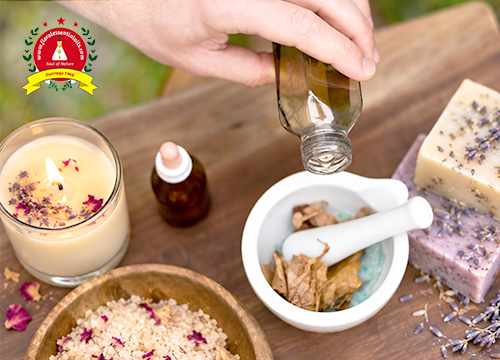
Good DIY essential oil recipes do more than list pretty blends. They tell you exactly how much oil to add, when to add it and which scents will survive the process. This maker’s hub covers soap, candles, body scrubs, balms, roll-on perfume, room sprays and incense, with recipe cards you can follow today.
Key takeaways
- Measure oils by weight, not drops.
- Cold process soap usually takes about 3% essential oil by weight of the soaping oils; strong oils like peppermint and clove need less.
- Candles typically hold a 6–10% fragrance load, added at the temperature your wax supplier recommends.
- Leave-on skin products stay mild: about 0.5% for lips and 1–2% for body butters.
- Fragrance oils often outperform essential oils in candles.
- Test with 250 ML bottles, then scale up to 25 L.
How to Use DIY Essential Oil Recipes Safely
All DIY essential oil recipes share a few ground rules. First, oils are concentrated, so a little goes a long way. Second, each product has its own usage rate. Soap and candles carry more scent, while leave-on skin products need gentle dilution.
Weigh ingredients on a scale that reads to 0.1 g. Drops vary with bottle size and oil thickness. As a result, drop recipes smell different every time you scale them.
Also keep separate pots and spatulas for crafting. Stainless steel, heat-proof glass and silicone work well, but avoid aluminum with lye.
Usage rates at a glance
The chart below shows starting usage rates. Then adjust for the oil; for example, peppermint and clove sit at the low end.
Wear gloves and goggles with lye and hot wax. Patch test leave-on products for 24 hours. Cold-pressed bergamot, lemon, lime and grapefruit are phototoxic, so keep them out of leave-on products worn in the sun. Avoid strong oils around babies, ask a doctor during pregnancy, and keep sprayed oils away from cats.
Essential Oils vs Fragrance Oils for Making
Both have a place. Essential oils are distilled or pressed from real plants. Fragrance oils, on the other hand, are designed blends built for performance and scent range.
A lavender soap can use either. However, a “cucumber” or “jasmine” soap usually needs a fragrance oil, because cucumber has no essential oil and jasmine absolute is costly. Our fragrance oils for soap, candle and perfume are made for exactly these jobs.
Side-by-side comparison
| Point | Essential oils | Fragrance oils |
|---|---|---|
| Source | Plant material, by distillation or pressing | Blended aroma materials, often with some naturals |
| Scent range | Limited to what plants yield | Wide: bakery, fruit, “fresh linen”, florals |
| Soap performance | Citrus top notes can fade; woods and resins last | Usually stable, but some accelerate trace |
| Candle throw | Softer; some oils burn off quickly | Usually stronger hot and cold throw |
| Aromatherapy use | Yes, when diluted correctly | No, scent only |
For a deeper comparison of blends that behave well in cold process, read which fragrance oils work best for soap making.
DIY Essential Oil Recipes for Soap
Soap is where most makers start. Before choosing oils, however, pick your method.
Cold process vs melt-and-pour
Cold process soap is made from oils and sodium hydroxide (lye). It needs protective gear and a four to six week cure. Melt-and-pour, by contrast, uses a ready-made base that you melt, scent and pour. It suits beginners.
Because lye is caustic, run every cold process recipe through a reputable lye calculator. Never guess lye or water amounts. Our guide to the best base oils for making soap explains how olive, coconut, shea and castor change hardness and lather.
How much essential oil goes in soap?
A common starting point is about 3% essential oil by weight of your soaping oils, so 1,000 g of oils takes about 30 g. Strong oils need less; keep peppermint near 1.5–2% and clove below 1%. In melt-and-pour, use 1–2% of the base.
Which essential oils anchor in soap, and which fade
High pH and a long cure are hard on top notes. Consequently, sweet orange and lemon often fade within weeks, while woods, roots and grassy oils last. So pair every fading note with an anchor.
| Behavior in cold process | Oils | Tip |
|---|---|---|
| Strong anchors | Patchouli, cedarwood atlas, vetiver, litsea cubeba, lemongrass | Use as 20–40% of the blend |
| Reliable middles | Lavender, rosemary, geranium, clary sage | Good as the main scent |
| Quick to fade | Sweet orange, lemon, bergamot, grapefruit, mandarin | Pair with litsea or a base note |
| Use with care | Clove, cinnamon leaf, peppermint | Lower usage; clove may speed trace |
For a ranked shortlist, see the 10 best essential oils for soap making, compared by scent strength.
- Soaping oils, 1,000 g total: olive 400 g, coconut 300 g, shea butter 250 g, castor 50 g
- Sodium hydroxide and water: from a lye calculator at 5% superfat
- Essential oils, 30 g (3%): lavender 21 g, patchouli 9 g
Add the essential oils at light trace. Pour, insulate for 24 hours, cut, then cure for four to six weeks.
Cucumber soap: benefits and a simple recipe
Cucumber soap is loved for its fresh, mild feel and soft green tint. However, cucumber leaves little scent in soap. Therefore, the aroma must come from spearmint, lavender or a green fragrance oil.
- 600 g clear or aloe melt-and-pour base
- 1 tbsp finely grated cucumber, squeezed dry (or 1 tsp cucumber juice)
- 9 g essential oils (1.5%): spearmint 5 g, lavender 4 g
Melt the base below 70°C (160°F), stir in the cucumber and oils, then pour. Because fresh produce shortens shelf life, use the bars within two months.
For cold process versions, see our soothing homemade cucumber soap recipe.
Peppermint soap benefits
Peppermint soap feels cooling and invigorating, thanks to menthol, which is why it is a summer favorite. However, it can feel intense on the face or sensitive skin, so keep it for the body. Try our cooling peppermint soap recipes for summer for more blend ideas.
Candles: Fragrance Load, Flash Point and Add Temperature
Candles are the most technical DIY essential oil recipes here. Three numbers matter most: fragrance load, add temperature and wick size.
Fragrance load
Fragrance load is the weight of oil compared with the weight of wax. Most soy blends hold 6–10%, but check your wax supplier’s maximum. Overloading makes oil sweat on the surface and can cause soot.
Flash point and add temperature
The flash point is the lowest temperature at which an oil’s vapor can ignite near an open flame. It matters mostly for storage and shipping. However, low flash point oils such as citrus evaporate faster from very hot wax.
Therefore, follow your wax’s recommended add temperature, often 82–85°C (180–185°F) for soy. Then stir gently for two minutes.
- 454 g (1 lb) container soy wax
- 36 g oil blend (8%): lavender 20 g, cedarwood atlas 10 g, sweet orange 6 g
- Two wicks sized for your jar diameter (check the wick maker’s chart)
Stir the oils in at the add temperature, pour at about 57°C (135°F), then cure for one to two weeks.
Essential oils throw softer than fragrance oils, so many makers blend both. For gourmand ideas, follow our guide to making coffee scented candles.
Never leave a burning candle unattended, and keep it away from pets and curtains.
Body Scrubs, Butters and Lip Balm
Skin care DIY essential oil recipes need a gentler hand. Therefore, use less oil and patch test before gifting.
What is the best essential oil for a sugar scrub?
It depends on the mood you want. Lavender and Roman chamomile feel calming, while sweet orange and spearmint feel fresh. Avoid cold-pressed lemon, lime, bergamot or grapefruit before sun exposure.
- 200 g fine white or brown sugar
- 100 ml fractionated coconut oil or sweet almond oil
- 20 drops essential oil: sweet orange 14, lavender 5, vanilla oleoresin 1
Mix the oils into the carrier, then fold in the sugar. Use on damp skin and rinse well. With a dry spoon, it keeps for about three months.
Our full list of the best essential oils for sugar body scrubs includes salt and coffee variations too.
Body butter instead of lotion
Water-based lotions need an emulsifier and a preservative, or mold can grow within days. For beginners, a whipped body butter is safer because it contains no water.
- 60 g shea butter, 30 g coconut oil, 10 g jojoba oil
- 1 g essential oil, about 1% (roughly 20 drops): lavender and frankincense
Melt, chill until just firm, then whip in the oils. When you are ready for emulsions, our summer body lotion guide walks through the extra steps.
Lip balm
Lips are sensitive, so keep essential oils near 0.5% and skip hot spices. For example, 10 g each of beeswax, shea butter and almond oil fills six tubes. Add three drops of sweet orange or lavender as it cools.
Roll-On Perfume and Cologne with Essential Oils
Perfume is built in notes. Top notes come first, heart notes form the body, and base notes linger for hours.
How to choose base notes
Base notes decide how long your perfume lasts. Sandalwood feels creamy, vetiver smoky and vanilla sweet. Our guide on how to decide the base notes for your perfume explains how each one changes the dry-down.
- 10 ml jojoba oil in a glass roller bottle
- 10 drops total (about 5%): sandalwood 3, vetiver 1, lavender 3, ylang ylang 1, sweet orange 2
Rest for 48 hours, then apply to wrists, avoiding broken skin.
Essential oil cologne for men
Men’s blends lean on woods, herbs and a touch of spice. For example, cedarwood and vetiver form a strong base, while lavender and black pepper add character. For more combinations, see our guide to crafting men’s fragrance with essential oils.
- 10 ml jojoba or fractionated coconut oil
- 10 drops total (about 5%): cedarwood atlas 3, vetiver 1, frankincense 2, lavender 2, sweet orange 1, black pepper 1
Bergamot is a classic cologne note. However, standard bergamot is phototoxic, so keep it below 0.4% in leave-on products unless the label says bergapten-free. Also, a matching DIY aftershave recipe can use this same blend at half strength.
Room and Linen Sprays
Of all the DIY essential oil recipes here, sprays are the quickest. Oil and water do not mix, however, so add alcohol and shake well.
- 80 ml distilled water or rose floral water
- 20 ml high-proof perfumer’s alcohol or vodka
- 40 drops essential oil (about 2%): lavender 20, cedarwood 10, sweet orange 10
Mix the oils into the alcohol first, then add the water. Test on hidden fabric, and air the room if pets or children are around.
Incense Sticks and Dhoop
Incense has deep roots in India, and many makers now scent blank sticks at home. Is incense or an essential oil better? They do different jobs. Incense burns and makes smoke, whereas a diffuser releases scent without combustion. Consequently, diffusers suit small rooms better.
Essential oils that smell like incense
Frankincense, sandalwood, vetiver and cedarwood give a warm, temple-like aroma, and nag champa adds a traditional Indian character. See our list of the top essential oils for incense sticks for tried pairings.
- 50 unscented bamboo incense blanks
- 20 ml dipping blend: 10 ml aroma oils (frankincense 4 ml, sandalwood fragrance oil 4 ml, vetiver 2 ml) plus 10 ml dipropylene glycol (DPG)
Coat the sticks in a long tray, then dry them upright for 24–48 hours in the shade. Burn in a ventilated room, away from children and pets.
For dhoop cones, knead 2 tbsp makko powder, 1 tbsp sandalwood powder, 20 drops of oil and a little water. Shape cones and dry for three to five days.
Buying in Bulk: Tips for Small Makers
Once your DIY essential oil recipes start selling, oil becomes your biggest cost. Larger sizes lower the cost per batch.
- Sample first. Start with a 250 ML bottle and make three test batches.
- Scale in steps. Every oil comes in nine pack sizes, from 250 ML up to 25 L, so move up gradually.
- Store it well. Keep oils cool and dark, and decant drums into full smaller bottles to limit oxidation.
- Record lot numbers on every batch sheet.
- Check the data. Ask for flash point and safety information before shipping candles. Start with our technical information page.
Citrus oils oxidize fastest, so buy only a year’s supply. As a manufacturer and exporter in Kannauj since 1962, we are happy to help makers plan order sizes.
Frequently asked questions
What are the benefits of peppermint soap?
Peppermint soap gives a cooling, tingly feel from menthol and a bright scent many people find invigorating on hot days. It is a cosmetic cleanser, not a treatment. Because it can feel strong, use it on the body rather than the face.
What is the best essential oil for a sugar scrub?
Lavender, sweet orange, spearmint and Roman chamomile are reliable because they smell pleasant and are usually gentle when diluted. About 20 drops in a 300 g jar keeps the level low. However, avoid cold-pressed lemon, lime, grapefruit and bergamot before sun exposure.
How do you make cucumber soap at home?
Melt-and-pour is easiest. Melt 600 g of clear base and stir in a tablespoon of squeezed, grated cucumber and about 9 g of spearmint and lavender oil. Pour into molds. The cucumber adds color, while the oils add scent. Use within two months.
Is incense or essential oil better for home fragrance?
It depends on the room. Incense burns and creates smoke, so it suits ventilated spaces and rituals. A diffuser releases scent without combustion, which suits bedrooms and small rooms. Either way, air the room well and keep children and pets in mind.
What are the best essential oils for a men’s cologne?
Cedarwood, vetiver, sandalwood and frankincense make long-lasting bases. Lavender adds a clean heart, while black pepper adds spice. Keep a roll-on at about 5 percent in jojoba. Also, limit standard bergamot to 0.4 percent in leave-on products because it is phototoxic.
How much essential oil should I put in a candle?
Most container waxes hold a 6 to 10 percent fragrance load by weight. For 454 g of soy wax, that is roughly 27 to 45 g of oil. Add it at your wax’s recommended temperature, then stir for two minutes.
Stock your maker’s shelf from Kannauj
From test bottles to 25 L drums, get essential oils, fragrance oils and carriers for soap, candles and perfume in one place, straight from a manufacturer.
This article is for educational purposes only and is not medical advice. Consult a qualified healthcare professional before using essential oils if you are pregnant, nursing, have a health condition or take medication. Essential oils are for external use only when properly diluted; do not ingest them, and keep them away from eyes, children and pets. For deeper safety data, see the Tisserand Institute.
 Chat with us !